Acoustic
📅 Published: 2026-04-19 10:47 | 🔄 Last Updated: 2026-05-12 17:01
https://cyberdefenders.org/blueteam-ctf-challenges/acoustic/
SIP and SIPVicious
SIP
SIP (Session Initiation Protocol) acts like a "receptionist" for a VoIP PBX system. It does not transmit audio (voice) directly; instead, it is responsible for establishing, controlling, and terminating calls. Below are the most common methods used by SIP devices to communicate with each other:
- REGISTER: Similar to arriving at a hotel and telling the receptionist: 'I am employee 101, and I am currently at this IP address. If anyone calls 101, please route the call to me.' Attackers often abuse this method to brute-force passwords.
- INVITE: This is the action of picking up the phone and dialing a number. It conveys the message: 'Ring ring! I want to establish a call with you, are you available?'.
- ACK: After the receiving end picks up (responding with a
200 OKcode), the initiator sends an ACK to confirm the connection. - BYE: The action of hanging up to terminate the call.
- CANCEL: Used when you call someone, the phone is ringing, but you change your mind and hang up before they answer.
- OPTIONS: Similar to a ping command. It is used to query whether the other end is online or to find out what features it supports. Attackers frequently use this command to scan a network for IPs running SIP servers.
SIPVicious
SIPVicious is a Python-based security suite designed to audit and attack SIP-based VoIP PBX systems. It is one of the most widely abused tools for automatically scanning and cracking VoIP systems globally, typically for toll fraud or eavesdropping. It consists of 5 main modules:
- svmap: Scans the network to discover active SIP devices or servers. It sends SIP OPTIONS requests everywhere and analyzes the responses to map the targets.
- svwar: Used for enumeration. Once a PBX system is found, it scans to identify valid extensions or usernames existing on that system.
- svcrack: An online password brute-force cracker. It continuously sends SIP REGISTER packets to guess passwords.
- svreport: Extracts and formats the results from the scanning and cracking sessions into a report file.
- svcrash: Sends deliberately malformed SIP packets to cause a Denial of Service (DoS). Attackers can also use this to counter-attack honeypots or malware analysis systems trying to trap them.
Detection Methods:
- User-Agent: Look for 'friendly-scanner' or 'SIPVicious'. Note that attackers can easily spoof or change this string.
- Network Anomalies: Monitor for sudden spikes in UDP traffic on Port 5060 or 5061. An
svcrackattack will generate a 'storm' of rejected REGISTER requests (returning401 Unauthorizedor403 ForbiddenHTTP/SIP error codes) originating from a single IP address. - PBX System Logs: When analyzing logs on PBX systems like Asterisk, FreePBX, or 3CX, a massive number of authentication attempts across sequential user ranges (e.g., scanning continuously from extension 1000 to 1999) is clear evidence of
svwaractivity
-------------------------
Source: 210.184.X.Y:5209
Datetime: 2010-05-02 01:49:56.063150

Message:

REGISTER sip:honey.pot.IP.removed SIP/2.0
Via: SIP/2.0/UDP 127.0.0.1:5089;branch=z9hG4bK-149719434;rport
Content-Length: 0
From: "102" <sip:102@honey.pot.IP.removed>
Accept: application/sdp
User-Agent: friendly-scanner
To: "102" <sip:102@honey.pot.IP.removed>
Contact: sip:123@1.1.1.1
CSeq: 1 REGISTER
Call-ID: 3489261283
Max-Forwards: 70


-------------------------
Source: 210.184.X.Y:5209
Datetime: 2010-05-02 01:49:56.693011

Message:

REGISTER sip:honey.pot.IP.removed SIP/2.0
Via: SIP/2.0/UDP 127.0.0.1:5089;branch=z9hG4bK-2386985930;rport
Content-Length: 0
From: "102" <sip:102@honey.pot.IP.removed>; tag=X_removed
Accept: application/sdp
User-Agent: friendly-scanner
To: "102" <sip:102@honey.pot.IP.removed>
Contact: sip:123@1.1.1.1
CSeq: 2 REGISTER
Call-ID: 680412875
Max-Forwards: 70
Authorization: Digest username="102",realm="localhost",nonce="2932135223",uri="sip:honey.pot.IP.removed",response="MD5_hash_removedXXXXXXXXXXXXXXXX",algorithm=MD5
This is an example of two consecutive packets sent by the attacker. Packet 1 is sent to trigger a response from the server, which replies with a 401 Unauthorized error. For Packet 2, the attacker initiates the brute-force attempt: the tool takes the nonce string provided in the server's previous response, combines it with a guessed password (from a dictionary), and hashes everything using the MD5 algorithm to generate the response string sent back to the server."
Basic triage
| 172.25.105.3 - victim | 172.25.105.40 | |
|---|---|---|
| 172.25.105.43 (Linux) - attacker | 172.25.105.40 (honey pot) | |
maint:password
172.25.105.43 (Linux)
ip.src==172.25.105.43 && http
Q1 What is the transport protocol being used?
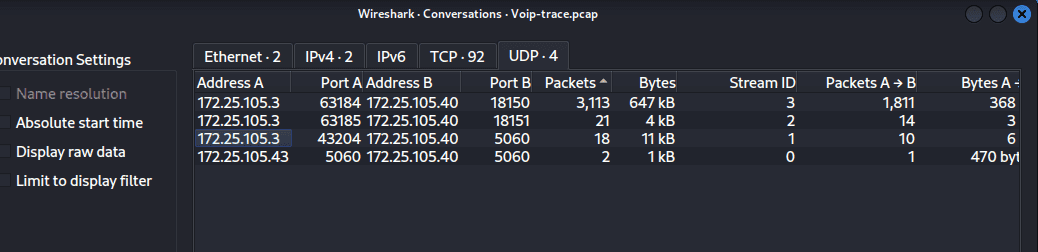
Connection between 172.25.105.3 and 172.25.105.40 use mostly UDP
UDP
Q2 The attacker used a bunch of scanning tools that belong to the same suite. Provide the name of the suite.
Use provided logs: "Friendly-scanner" is a well-known User-Agent string associated with "SIPVicious," a set of open-source security tools used to scan and audit VoIP (Voice over IP) systems, often for malicious purposes
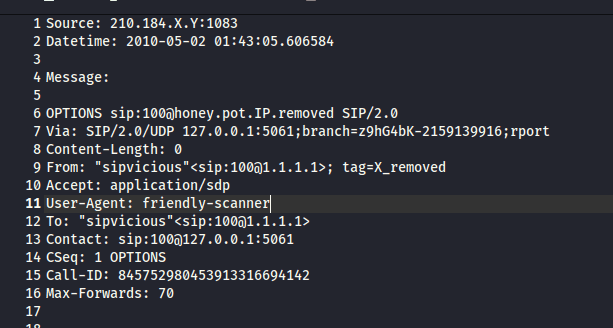
SIPVicious
Q3 What is the User-Agent of the victim system?
filter: ip.addr==172.25.105.3 and follow UDP stream
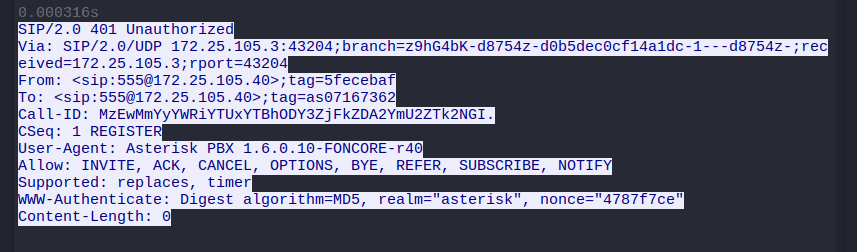
Asterisk PBX 1.6.0.10-FONCORE-r40
Q4 Which tool was only used against the following extensions: 100,101,102,103, and 111?
I use this command to find out attack pattern
grep -E 'friendly-scanner' -A 1 log.txt | grep -oE "sip:(100|101|102|103|111)@" | sort | uniq -c
      4 sip:100@
    173 sip:101@
    171 sip:102@
    193 sip:103@
   1060 sip:111@
There’s a clear sign of brute forcing into those accounts above. So the answer should be
svcrack.py
Q5 Which extension on the honeypot does NOT require authentication?
this authorization field is for user 101.
Authorization: Digest username="101",realm="localhost",nonce="3711809134",uri="sip:honey.pot.IP.removed",response="MD5_hash_removedXXXXXXXXXXXXXXXX",algorithm=MD5
I use this command
grep -oP 'Authorization: Digest username="\d+"' log.txt | sort | uniq
Authorization: Digest username="101"
Authorization: Digest username="102"
Authorization: Digest username="103"
Authorization: Digest username="111"
There is no Authorization field for username: 100
100
Q6 How many extensions were scanned in total?
REGISTER sip:9994@honey.pot.IP.removed SIP/2.0

┌──(cuong_nguyen㉿Kali)-[~/Desktop/cyberdefenders.org/temp_extract_dir/Acoustic]
└─$ grep -Ei "REGISTER sip:" log.txt | grep -v "sip:honey.pot" | wc -l
2652
Q7 There is a trace for a real SIP client. What is the corresponding user-agent? (two words, once space in between)
i use this command to find all the user agent
grep -Ei "User-agent" log.txt| uniq
User-Agent: friendly-scanner
User-Agent: Zoiper rev.6751
Zoiper rev.6751
Q8 Multiple real-world phone numbers were dialed. What was the most recent 11-digit number dialed from extension 101?
Check for INVITE request type as we learned before. The “Uknown” is default value when creating INVITE request.
└─$ grep -Ei 'From: "Unknown"<sip:101' log.txt -B8 | grep INVITE
INVITE sip:900114382089XXXX@honey.pot.IP.removed;transport=UDP SIP/2.0
INVITE sip:00112322228XXXX@honey.pot.IP.removed;transport=UDP SIP/2.0
INVITE sip:00112524021XXXX@honey.pot.IP.removed;transport=UDP SIP/2.0
The most recent one is:
00112524021XXXX
Q9 What are the default credentials used in the attempted basic authentication? (format is username:password)
search for “password” or “credentials” in the wireshark packet search box.
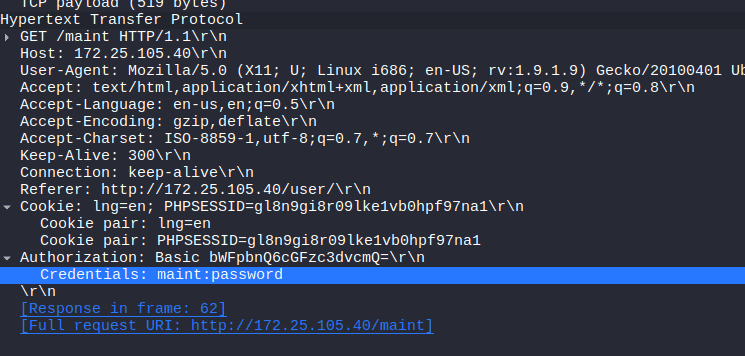
maint:password
Q10 Which codec does the RTP stream use? (3 words, 2 spaces in between)
ITU-T: International Telecommunication Union (the agency that issued this standard).
- G.711: The code name for the audio codec standard designed for the human voice.
- PCM (Pulse Code Modulation): A technique that converts analog (natural) sound waves into digital signals (0s and 1s).
- U (µ-law or Mu-law): A specific companding (compressing and expanding) algorithm. Note: There are two global versions of G.711: PCMU (µ-law, used mainly in North America and Japan) and PCMA (A-law, used in Europe and other regions).
- Sample Rate: 8,000 Hz (8kHz). It only samples within the human voice frequency range (300Hz to 3400Hz) to save bandwidth.
- Bitrate: 64 kbps.
- Quality: It does not compress files like MP3, meaning the audio quality is lossless for voice. It sounds very clear, like a standard landline call. However, it consumes significantly more network bandwidth compared to modern codecs (like G.729 or Opus).
ITU-T G.711 PCMU
Q11 How long is the sampling time (in milliseconds)?
Sample Rate (Frequency): G.711 PCMU uses a frequency of 8,000 Hz (meaning 8,000 samples are taken per second). Sampling Time (Period): This is the duration required to take a single sample. The basic physics formula is T = 1/f."
1/8000=0.000125 = 0.125 ms
Q12 What was the password for the account with username 555?
PBX systems like Asterisk or FreePBX need to download configuration files from a server to determine extension numbers and passwords. These are usually transmitted via FTP or HTTP. The vulnerability here is that the server allows downloading these .conf files without authentication. Attackers hunt for these files to extract passwords
- sip_custom.conf
- http.request.uri contains "sip_custom.conf”
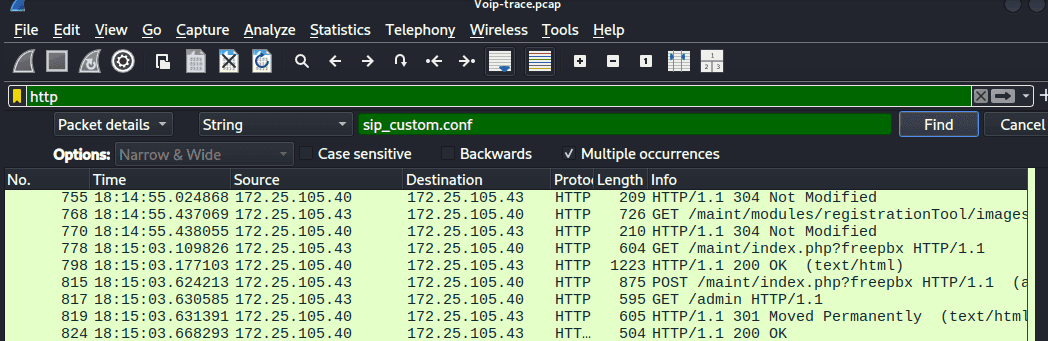
Follow the TCP stream

1234
Q13 Which RTP packet header field can be used to reorder out of sync RTP packets in the correct sequence?
I used google to do a search
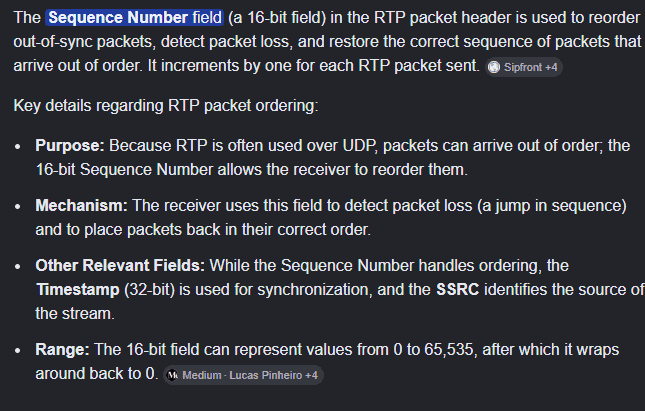
But the Sequence number is not the answer. I tried the timestamp And turns out it is the correct one.
timestamp
Q14 The trace includes a secret hidden message. Can you hear it?
Navigate to Telephony → VoIP calls → play streams. There are 2 voice streams. Listen you’ll find out the answer.
mexico